[ad_1]

Monday March 17, 2025

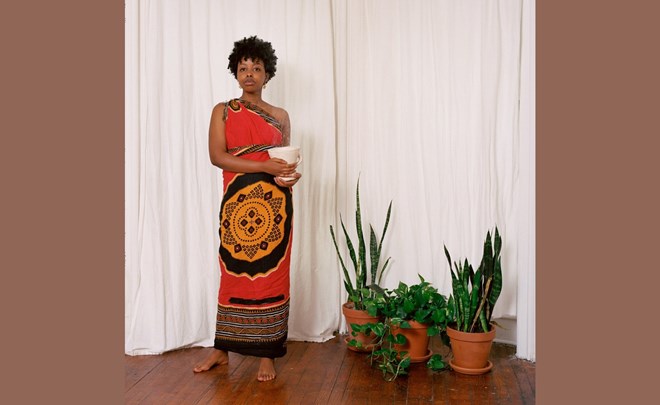
Somali-American chef and writer Ifrah Ahmed, founder of Milk and Myrrh, photographed by June Canedo.
Toronto, Canada (HOL) — Ifrah F. Ahmed, a Somali-born chef and writer, is pioneering efforts to preserve and promote Somali cuisine through her culinary pop-ups and food writing. Based between New York and Seattle, Ahmed’s work centers on food culture, migration, and the oral traditions of Somali cooking, blending culinary artistry with historical documentation.
A contributor to The New York Times Cooking, Ahmed founded Milk and Myrrh, a pop-up experience introducing audiences to Somali cuisine. Through these events, she addresses the absence of written records in Somali culinary culture, which has long relied on oral transmission.
Ahmed’s passion for food was shaped by her upbringing in Seattle, where her mother ensured the family remained connected to Somali traditions. She recalls childhood memories of “Hooyo’s Cooking School,” where she learned the intricacies of Somali tea and other staple dishes.
“Somali dishes were the core,” Ahmed said. “We would cycle between rice and spaghetti, usually with goat meat or thinly sliced steak. And then we had anjero, which is similar to Ethiopian injera but tastes completely different.”
She also remembers her early fascination with American cuisine. “One of my earliest memories of being in America is we lived like right around the corner from a McDonald’s in our very first apartment in Seattle,” she said. “Every morning, when my mom would open the window, the first smell that I would get is the McDonald’s french fry smell.”
Ahmed’s transition to food writing was a natural extension of her love for literature and storytelling. Her work has been featured in The New York Times, where she advocates for broader representation of Somali and Muslim cuisines.
“Food writing probably became much later, like more into adulthood,” she said. “But I was really just into writing and reading in general when I was young and still am. I was like a book nerd… But I didn’t know food writing existed like in high school, college, or anything like that. It wasn’t until I came to New York that I really started getting into food writing.”
Recognizing the lack of documented Somali recipes, Ahmed collaborates with linguists and historians to preserve oral traditions in written form. “I don’t feel like just a recipe developer,“ she said. “Sometimes, I feel like a historian or detective, piecing together fragments of our culinary heritage.”
Ahmed launched Milk and Myrrh in response to the underrepresentation of Somali food in mainstream culinary spaces. The name was inspired by a vintage Somali cookbook, which referred to Somalia as “The Land of Milk and Myrrh.”
Her pop-ups, hosted in cities like Los Angeles, Seattle, and Brooklyn, showcase seasonal and regional variations of Somali dishes. In Los Angeles, she incorporates plant-forward meals, while seafood takes center stage in Seattle. Notably, she introduced a Somali-style breakfast burrito, blending traditional anjero with a contemporary twist.
“I wanted to do something more casual because it was like these people love breakfast burritos,” she said. “This is a city that loves breakfast burritos, and at that point, I had thought up of a Somali-style anjero burrito about like 10 years prior. I think I like tweeted about it or something… And I made the Somali-style breakfast burritos, and that experience is a little different than the formal fancy kind of plated dinner—it’s very casual… But people loved it!”
For Ahmed, documenting Somali cuisine presents unique challenges, as recipes have historically been passed down verbally. Measuring ingredients and standardizing instructions require extensive research and adaptation. She sees herself as a culinary translator, bridging generations and ensuring the preservation of Somali food heritage for future audiences.
“For recipe developers and chefs like myself who don’t come from a culture in which things are documented via writing, like recipe writing, we’re not just doing the recipe development portion,” she said. “You know, sometimes I feel like a historian. Sometimes I feel like a detective. I’m tracking people down, I’m going into archives that like barely have the resources that I’m looking for.”
Ahmed is currently working on her first cookbook, focusing on the impact of forced migration on Somali cuisine. The book will highlight the adaptation of Somali food across the diaspora while featuring contributions from Somali culinary professionals worldwide.
“I hope that my work is an example or a demonstration of really not having to choose between your identities and being able to be authentic in whatever space that you’re in,” she said. “I hope that my work inspires a love or intentionality to remain connected to whatever your home culture or your parents’ culture is. And I hope that I can encourage other people to try to preserve those cultures as well, whether they’re Somali or not.”
[ad_2]
Read More