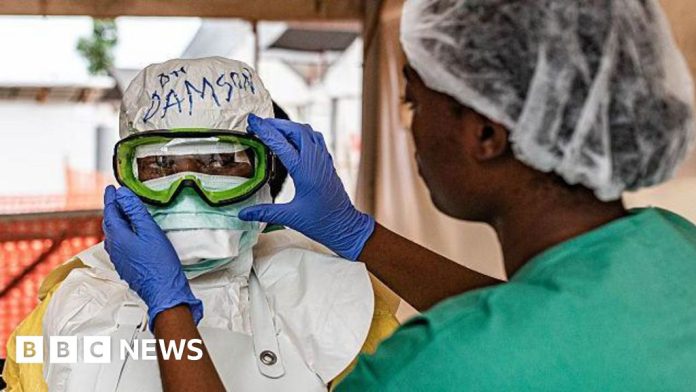
What is Ebola and why is stopping the latest outbreak so difficult?
An Ebola outbreak in the Democratic Republic of Congo has been declared a public health emergency of international concern, by the World Health Organization (WHO).
The latest outbreak is challenging because it involves a rare species of Ebola for which there is no vaccine, and the epicentre is in an area affected by conflict.
What is Ebola and what are the symptoms?
Ebola is a rare but deadly disease caused by a virus.
Ebola viruses normally infect animals, typically fruit bats, but outbreaks among humans can sometimes start when people eat or handle infected animals.
It takes two to 21 days for symptoms to appear. They come on suddenly and start like the flu or malaria, with fever, headache and tiredness.
As the disease progresses, vomiting and diarrhoea develop and it can lead to organ failure. Some, but not all, patients develop internal and external bleeding.
The virus spreads from one person to another by contact with infected bodily fluids such as blood or vomit.
Ebola outbreaks used to be small and contained to remote rural areas. However, urbanisation is pushing larger populations closer to these natural reservoirs of Ebola and increasing the risk of transmission.
Why is this Ebola outbreak different and is there a vaccine?
This outbreak is caused by the rare Bundibugyo species of Ebola, which had not been seen for over a decade.