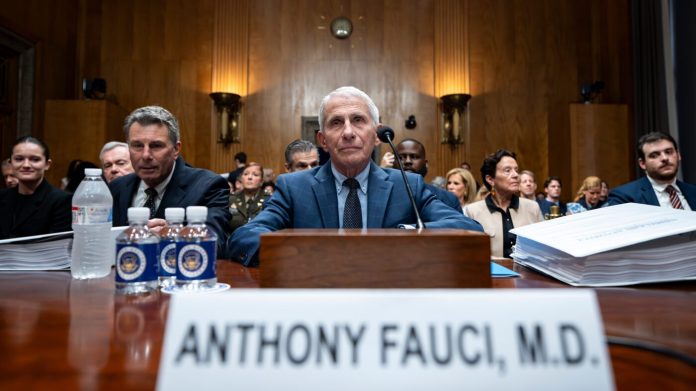
After Fauci Senate hearing, experts worry about ‘chilling effect’ on public health
News
For almost three hours on Wednesday morning, Dr. Anthony Fauci sat before the Senate Committee on Homeland Security and Governmental Affairs and declined to answer questions about the origins of the COVID-19 pandemic.
Instead, he invoked his Fifth Amendment right more than a hundred times — which later led Sen. Rand Paul, R-Ky., to say he would push to hold Fauci in contempt of Congress next week.
These moves have once again foregrounded Paul’s unproven claims that the SARS-Cov-2 virus came from a lab leak and that Fauci covered it up — a charge the scientist has vociferously denied. But the renewed attacks on Fauci, once the nation’s leading infectious disease expert, have caused Democrats, health workers and researchers to worry that these events may further erode public health staffing and infrastructure in the U.S.
Details
“These firings and these cuts — they’re creating a chilling effect, honestly,” Andy Kim, D-N.J., said at the hearing, while also thanking Fauci and decrying what he called the demonization of public servants. “A chilling effect for the next generation of people who might consider stepping up to serve our nation, to be the next generation of researchers who now are wondering whether or not this is the right thing for them to do at a time when they see some of their colleagues, or those that they
Other public health professionals agree that what played out on Capitol Hill earlier this week is part of a larger corrosion of the field to which they’ve dedicated their lives, endangering its future and undermining health outcomes in the U.S.
“I thought that we were healing as a country around COVID-19,” says epidemiologist Katelyn Jetelina. “I think what yesterday did was open some really deep wounds.”
Analysis
During the pandemic, there was a surge in people asserting their right to reject various medical treatments and public health interventions. It’s a movement that’s often called health freedom.
“People were rejecting things like schools demanding that children be vaccinated for COVID before they return to school,” says Nicole Huberfeld, a professor of health law at Boston University. But those claims, she says, were not based on empirical evidence. “Rather, they were rooted in often religious or moral objections to vaccination.”
There were other pandemic policies that became increasingly unpopular — masking, social distancing, and school and work closures. People may have accepted these restrictions initially, but “that moment wasn’t long-lived in part because there was fairly swift pushback from the top during the first Trump administration,” says Huberfeld.
Stay informed with the latest news on Wararka.so — your trusted source for Somalia and world news.