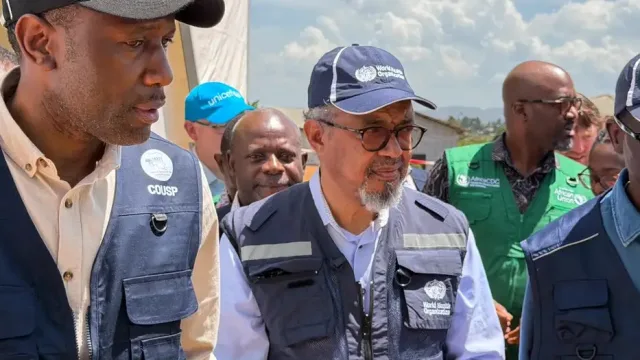
The World Health Organization head Tedros Adhanom Ghebreyesus has arrived in the Democratic Republic of the Congo, declaring that the deadly Ebola outbreak sweeping through the country “can be stopped” — but only if the international community acts decisively and with urgency.
On the Ground in Kinshasa
Tedros landed in the DRC capital Kinshasa on Thursday evening and was due on Friday to travel directly to Ituri province in the north-east, the epicentre of the epidemic. The WHO chief was met upon arrival by senior Congolese health officials and representatives from a string of international aid agencies working around the clock to contain the spread of the virus.
“That thing can be stopped,” Tedros told reporters at Kinshasa’s international airport, seeking to project cautious optimism despite the daunting scale of the crisis. He added that the WHO does not support travel bans as a measure to combat the outbreak, noting that such restrictions “don’t help much” and often serve only to disrupt critical supply chains and humanitarian access.
“Together, we will overcome this outbreak. I am here to do everything in my power to help you,” Tedros said in a video message posted to social media before his departure. “The world must not look away from this crisis.”
Alarming Death Toll and Case Numbers
The WHO has recorded 10 confirmed and 223 suspected Ebola deaths in the DRC since the outbreak was officially declared on 15 May, according to figures up to 24 May. More than 1,000 confirmed and suspected cases have been reported overall, though health experts warn that the true spread of the virus is likely considerably wider — as the virus is believed to have circulated undetected for some time before the outbreak was identified and declared.
This is the 17th recorded Ebola outbreak in the vast central African country, which has a population of more than 100 million people spread across territory ranging from dense tropical rainforest to densely populated urban centres.
Conflict Zones and the Challenge of Containment
Complicating every aspect of the medical relief effort, the epidemic is centred in a mineral-rich region that has been fought over for years by dozens of armed militia groups. The ongoing conflict and displacement of communities has made every aspect of the response — from contact tracing to safe burials — extraordinarily difficult to implement consistently.
“Conflict and displacement make everything harder. I am making a direct appeal to all warring parties in this region: please, declare a ceasefire,” Tedros said, issuing an extraordinary personal plea. “No cause, no conflict, no grievance is worth condemning innocent people to death from a preventable disease.”
Vaccine and Treatment Update
No vaccine or specific treatment yet exists for the Bundibugyo strain of Ebola that is causing the current outbreak — a strain that is distinct from the Zaire strain that caused West Africa’s catastrophic 2014–2016 epidemic. The WHO said on Thursday that its advisory groups had recommended urgent clinical trials for both vaccines and treatments, and that work to accelerate these trials was already underway.
The head of the African Union’s health agency, Jean Kaseya, said on Thursday that he expected a vaccine to be ready for deployment by the end of the year, though health experts caution that such timelines can slip as the complex manufacturing and regulatory approval processes unfold.
Neighbouring Countries on High Alert
Neighbouring Uganda, which has recorded one Ebola death and six additional cases, announced it was immediately shutting its border with the DRC in an attempt to prevent further cross-border transmission. The United States said it would deny entry to anyone found to be infected and was working to open a treatment facility for affected American citizens in Kenya. A Kenyan rights group has gone to court seeking to limit operations at any such facility, while health officials have warned it could place a significant burden on Kenya’s already stretched health system.
International Response Efforts
The WHO said it had received 4.6 tonnes of medical aid at the airport in Bunia, the capital of Ituri province, while Unicef, the United Nations children’s agency, said it was dispatching 100 tonnes of emergency aid to the DRC. International partners are scrambling to establish treatment centres, deploy vaccination teams, and train local health workers in infection prevention protocols.
Ebola has killed more than 15,000 people in Africa over the past 50 years. The deadliest previous outbreak in the DRC — which ran from 2018 to 2020 — claimed nearly 2,300 lives out of 3,500 recorded cases, according to WHO data. As the current outbreak continues to spread, health workers on the ground say they are operating in an environment of extreme pressure and limited resources, with the coming days likely to prove critical in determining whether the outbreak can be brought under control before it escalates further.
Additional reporting by agencies