
Dhaq-dhaqaaqka Beeraha ee Labaad ee Waqooyiga Dhexe ee Afrika: Xaaladaha Dabacsan ee Barafka iyo Hoos-u-dhafka Cabbirka
Xaaladaha dabacsan ee barafka iyo hoos-u-dhafka cabbirka ayaa saameyn weyn ku yeeshay beeraha labaad ee Waqooyiga Dhexe ee Afrika, iyadoo qaar ka mid ah gobollada ay ku jiraan hoos u dhac weyn oo barafka ah. Tani waxay keentay in beeraleyda ay ka fogaadaan beerashada, iyadoo xaaladuhu ay sii xumaanayaan.
Xaaladaha Beeraha ee Waqooyiga Dhexe ee Afrika
Xaaladaha dabacsan ee barafka iyo hoos-u-dhafka cabbirka ayaa saameyn weyn ku yeeshay beeraha labaad ee Waqooyiga Dhexe ee Afrika, iyadoo qaar ka mid ah gobollada ay ku jiraan hoos u dhac weyn oo barafka ah. Tani waxay keentay in beeraleyda ay ka fogaadaan beerashada, iyadoo xaaladuhu ay sii xumaanayaan.
Hoos-u-dhafka cabbirka barafka ayaa sii kordhay, iyadoo qaar ka mid ah gobollada ay ku jiraan hoos u dhac weyn oo barafka ah. Tani waxay keentay in beeraleyda ay ka fogaadaan beerashada, iyadoo xaaladuhu ay sii xumaanayaan.
Saameynta Beeraleyda iyo Xaaladaha Beeraha
Beeraleyda ayaa ka fogaaday beerashada, iyadoo xaaladuhu ay sii xumaanayaan. Hoos-u-dhafka cabbirka barafka ayaa sii kordhay, iyadoo qaar ka mid ah gobollada ay ku jiraan hoos u dhac weyn oo barafka ah.
Xaaladaha dabacsan ee barafka iyo hoos-u-dhafka cabbirka ayaa saameyn weyn ku yeeshay beeraha labaad ee Waqooyiga Dhexe ee Afrika, iyadoo qaar ka mid ah gobollada ay ku jiraan hoos u dhac weyn oo barafka ah. Tani waxay keentay in beeraleyda ay ka fogaadaan beerashada, iyadoo xaaladuhu ay sii xumaanayaan.
Xaaladaha Beeraha ee Waqooyiga Dhexe ee Afrika
Xaaladaha dabacsan ee barafka iyo hoos-u-dhafka cabbirka ayaa saameyn weyn ku yeeshay beeraha labaad ee Waqooyiga Dhexe ee Afrika, iyadoo qaar ka mid ah gobollada ay ku jiraan hoos u dhac weyn oo barafka ah. Tani waxay keentay in beeraleyda ay ka fogaadaan beerashada, iyadoo xaaladuhu ay sii xumaanayaan.
Hoos-u-dhafka cabbirka barafka ayaa sii kordhay, iyadoo qaar ka mid ah gobollada ay ku jiraan hoos u dhac weyn oo barafka ah. Tani waxay keentay in beeraleyda ay ka fogaadaan beerashada, iyadoo xaaladuhu ay sii xumaanayaan.
High temperatures and below-average rainfall have persisted for over two months across Central America's Central-Pacific region, severely compromising staple grain production for the second agricultural season and leaving many farmers unable to plant.
Persistent Drought Hits Guatemala and Honduras Hardest
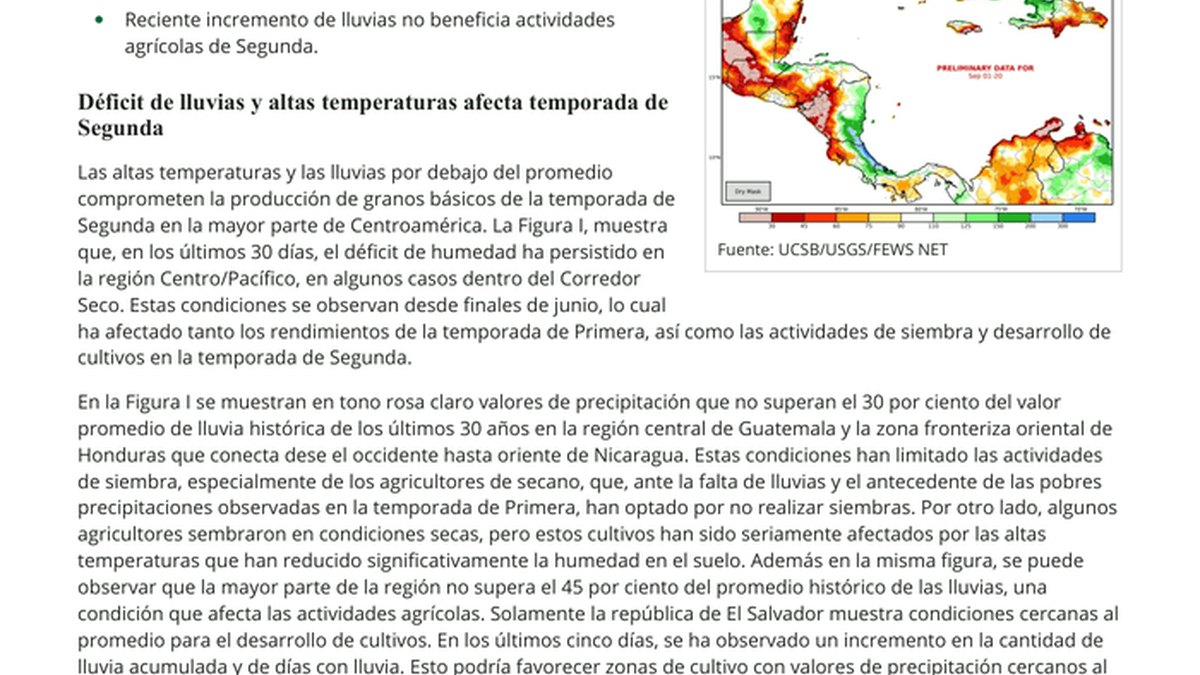
In the central region of Guatemala and the eastern border zone of Honduras, precipitation values have not exceeded 30% of the historical average rainfall over the last 30 years, creating severe conditions for agriculture. These conditions have been observed since late June, affecting both yields of the first season and planting activities for the second season. Some farmers planted under dry conditions, but these crops have been seriously affected by high temperatures that have significantly reduced soil moisture.
Most of the region does not exceed 45% of the historical average rainfall, a condition that affects agricultural activities across the board. Only the Republic of El Salvador shows conditions close to the average for crop development, offering a rare exception to the widespread deficit. These conditions have limited planting activities, especially for rain-fed farmers, who, in the face of lack of rains and poor precipitation observed in the first season, have opted not to plant.
Late Rain Surge Risks Flooding and Landslides
In the last five days, an increase in accumulated rainfall and rainy days has been observed across the region. This could favor cultivation zones with precipitation values close to the average that could help reduce humidity deficits, but would be insufficient and late to favor agricultural activities. The increase in precipitation could cause flooding and landslides that would affect the road network, harming transportation and communication routes.
Erratic and deficient rains are affecting second season planting, with the recent increase in rains not benefiting second season agricultural activities. The humidity deficit in cultivation zones is increasing due to high temperatures, creating a complex situation where farmers face both drought and the threat of sudden heavy rainfall.
Colombia and Venezuela Show Mixed Rainfall Patterns
In Colombia, deficient rainfall conditions persist and have increased in parts of Chocó, Antioquia, Sucre, parts of Bolívar and Magdalena, as well as in parts of eastern Venezuela. In contrast, central Venezuela and the departments of Santander and Norte de Santander in Colombia have recorded an increase in precipitation, presenting values between 10% to 25% above the average.
These areas present values between 10% to 25% above the average and are shown in green, favoring agricultural activities and crop development. Excepting eastern Venezuela, where long-term dry conditions are observed, in both countries an erratic distribution of rains has been observed, alternating conditions above the average with conditions below it. As a result, the balance to date is close to the average.
Ilaha iyo xuquuqda sawirka
Sawir: ReliefWeb Updates Xigasho