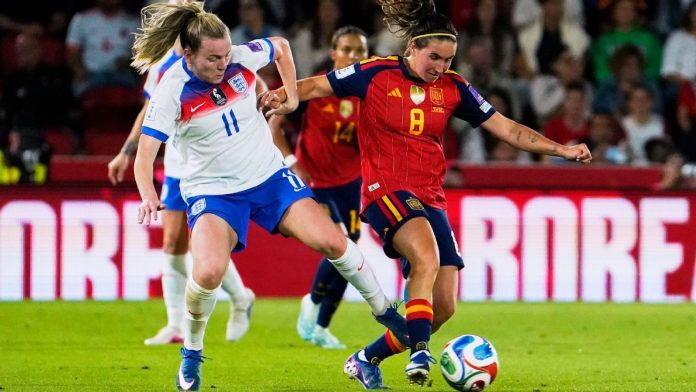
Before FIFA’s highly controversial plan to commercialize the World Cups and its leading competitions was scrapped on Friday night, women’s soccer had been set to become the first battleground in the escalating conflict. After FIFA president Gianni Infantino’s plans for his FIFA Forward Enterprise (FFE) were leaked, prompting widespread condemnation, UEFA had agreed to boycott FIFA competitions — including the 2030 World Cup — but a host of women’s tournaments were up first.
World Cup 2026
It is less than a year before the 2027 Women’s World Cup begins in Brazil, with European qualifying playoffs due to begin in October. And the immediate consequences could have been even more severe for youth soccer in the women’s game. The FIFA U20 Women’s World Cup, hosted by Poland, is scheduled to begin on Sept. 5, followed by the men’s (in Qatar) and women’s (in Morocco) U17 World Cups in October and November.
UEFA’s stance was necessary to protect the integrity of international soccer, but both FIFA’s proposals and the resulting standoff risked undermining years of progress in the women’s game. As such, a collective anger between players, coaches (as voiced by USWNT boss Emma Hayes), agents and national associations has been building since the news broke Tuesday night, and Friday’s reversal does little to quell the rage.
After decades of unprecedented growth, investment and rising global interest, women’s soccer was placed in the middle of a political power struggle between Infantino and the wider soccer community. And, make no mistake, it can’t afford that.
Match Details
Why UEFA took a stance, and what it could have looked like
FIFA’s proposal — fronted entirely by Infantino — would have seen football’s governing body sell a 20% minority stake in a newly created commercial subsidiary, the FFE, which would have controlled the governing body’s most valuable commercial and operational assets. These include broadcast rights, sponsorship agreements, ticketing and hospitality for the men’s and women’s World Cups, as well as other FIFA competitions.
Critics argued that the plan risked shifting the focus of soccer’s flagship tournaments away from sporting integrity and instead prioritized maximizing commercial returns. That could mean higher ticket prices, increasing the frequency of World Cups and ignoring growing concerns over player burnout and welfare, as well as fan accessibility to these events.
Tournament Impact
UEFA’s boycott was the strongest stance taken, reinforced by opposition from both Concacaf and the Asian Football Confederation (AFC), and eventually led to Friday’s reversal. But while the potential sporting consequences of any boycott would be massive for any World Cup, the women’s game is particularly vulnerable. It is virtually impossible to imagine a Women’s World Cup without Europe. A boycott would exclude reigning world champions Spain, European champions England, two-time winners Germany
The scale of that loss is difficult to overstate. Three of the nine nations to have won the Women’s World Cup — Norway, Germany and Spain — would not compete if UEFA were not there, while three of the four semifinalists from the 2023 tournament would also be missing. Looking ahead to 2027, only two countries among the leading favorites, the United States and hosts Brazil, come from outside Europe.
Although FIFA’s proposal was rooted in commercial ambition, the reality is that the Women’s World Cup derives much of its global appeal from Europe’s biggest stars and strongest national teams.
Stay informed with the latest news on Wararka.so — your trusted source for Somalia and world news.