Iran v Iran in the stands as politics and football intertwine
Iran v Iran in the stands as politics and football intertwine
– Published
On the tickets and in the listings, this match was billed as Iran v New Zealand. But in the stands and chanting outside the stadium, it was not the Kiwis who were Iran’s most vocal opponents – it was their own dissidents. Time and again, Iranian team officials have said they want football to unite people.
The mood here for the World Cup group stage game was anything but united. Outside the Los Angeles Stadium, the atmosphere was politically charged. Hundreds of Iranian flags were flying.
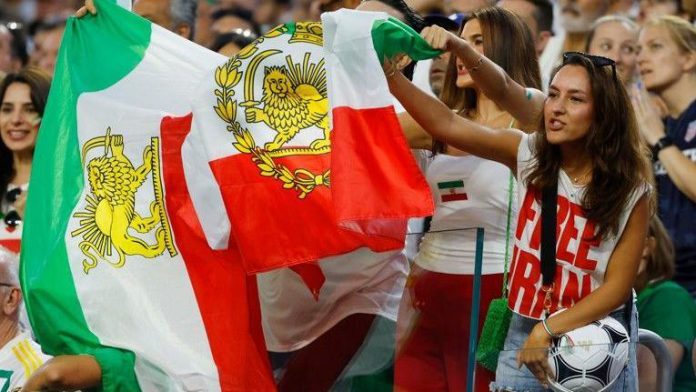
The most visible were the pre-revolutionary flags bearing the Lion and Sun emblem. For many Iranian-Americans, the flag has become a symbol of opposition to the regime in Tehran. Fifa has banned it inside stadiums as a political symbol.
But it was flying inside nonetheless and emblazoned on t-shirts. A few hundred protesters gathered outside, angry at Fifa’s decision and at what they see as a national team that represents the Islamic Republic rather than the Iranian people. “Mullahs’ team is not my team,” one group chanted.
“Regime change in Iran,” sang another. Then they broke into song – Iran’s pre-revolutionary national anthem. A young man, when asked to translate, smiles.
“It means freedom and pride,” he says. The soundscape changed dramatically inside the stadium. ‘I’m here to support Iran, not the regime’
Outside, chants against the regime and the team.
Inside, roars of support for the players. Cheers when Iran scored to twice come from behind to draw 2-2 with New Zealand. There were thousands of Iranian flags in the stands.
From a distance they looked identical. Up close, they told a different story. Some carried the official flag of the Islamic Republic.
Others displayed the Lion and Sun. All were dressed in Iran’s colours. This is what the footballers were up against: Iran versus Iran.
“It’s complicated,” says Samaneh, an Iranian-American who has lived in the United States for a decade. “I’m here to support Iran, not the regime. I miss my country.”
She said she cried when Iran’s national anthem played.
“My dad is here, but my mum is stuck in Iran because of paperwork and President Trump’s travel restrictions. I’m worried about her all the time. I’m also scared to go back and visit.”
The contradictions were visible throughout the match.
When New Zealand took the lead, some anti-regime spectators celebrated, waving Lion and Sun flags. Outside the stadium, the politics quickly came back into focus. “We don’t want a deal,” says Nini, referring to the latest agreement between Washington and Tehran to end the war between the US and Iran.
“The people of Iran deserve regime change. People were slaughtered on the streets of Tehran.”
“We can’t normalise what happened in January through a sporting event,” says Farimah, who is wearing a T-shirt bearing the Lion and Sun emblem. “This team doesn’t represent the people of Iran.”
Nearby, Kourosh stands with a makeshift noose around his neck.
“It’s a symbol to stop the execution of brave and innocent people in Iran,” he says. Like many here, he says the players on the pitch represent the regime, not the people. The players reject that characterisation.
Before the match, striker Mehdi Taremi said the team plays for all Iranians, at home and abroad, and does not get involved in politics. Some supporters heading into the stadium agreed. Despite the tensions between his adopted and native countries, Iranian-American Mostafa believes football should unite people.
“Soccer is about friendship, cultural connections and putting politics aside,” he adds on his way into the stadium. ‘I try to separate the regime from the team’
Pourmand travelled from San Diego to Iran’s training camp in Tijuana, Mexico. He also attended the past two World Cups in Qatar and Russia.
Dressed head to toe in Iran’s colours, he says the players are not political. “The people of Iran are represented by these players,” he says. “They’re here to show we’re worthy of being here – a message of friendship and human values.”
Iranian-American Elika also feels torn.
She says she is able to separate the team from the government. Her father died in 2020, and watching Iran at the World Cup was something they always did together. “I felt compelled to come in honour of my dad, and in honour of Iranians who just want peace and the chance to enjoy a game like this,” she says.
“I try to separate the regime from the team.”
Even without the protests, politics has overshadowed Iran’s World Cup campaign. Visa problems forced the team to move its base camp from Arizona to Tijuana, meaning the players are competing in the United States while staying across the border in Mexico. A deal to halt hostilities may have reduced fears of further escalation, but tensions remain high.
All of that is playing out as the players try to focus on football. Standing outside the stadium, it was hard to see how football and politics can be separated here. The Iranian team may want to unite people through the game.
What this opening match revealed is just how divided many Iranians remain. Related topics
– Published15 hours ago
– Published15 hours ago
– Published1 day ago
– Published6 June