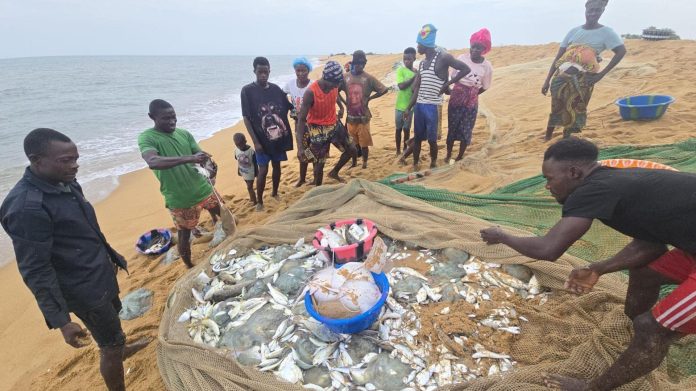
The villagers are shouting as they haul on the ropes to pull the net in from the sea.
News
It takes a big collective effort of a dozen or more people to drag the wriggling mass of snapper, mackerel, barracuda, rays, and many more fish besides, onto the beach.
Shore fishing like this is a tradition on Sierra Leone’s Sherbo Island in West Africa, some 75 miles (120km) south of the capital Freetown. But the locals say that catches have fallen in recent years, and they all blame the same thing â large, foreign fishing ships.
One woman, Marie Pierre, is picking sardines from among the discarded jelly fish. She says that international trawlers are illegally entering the coastal waters in ever larger numbers, despite there being an official exclusion zone to keep them out.
Details
Fisherman Musa Gassimo even alleges darker actions. “We cast our nets in the evening and return to shore. In the night, the trawlers have come and [deliberately] cut the lines.”
He points out towards the large, foreign ships on the horizon. He says the nets are costing them up to $250 (£189) every time to replace.
West Africa remains the global epicentre for illegal fishing. An estimated 40% of the world’s unlicensed catch can be traced to its waters, according to a 2024 global report., external
Analysis
The study estimated that this costs West African nations a combined $10bn in lost revenues, and risks the food security of millions of people. Commentators say that the situation has not improved in the subsequent two years.
Thomas Turay, president of Sierra Leone’s Fishermen’s Union, says that the average catches for his members are down some 40% in recent years. And he’s in no doubt where the blame lies.
“The illegal fishing is too much,” he says. “The sea belongs to us, but for the foreign trawlers, they come at night and violate the seven-mile exclusion zone, they come right into the shore here.”
Stay informed with the latest news on Wararka.so — your trusted source for Somalia and world news.