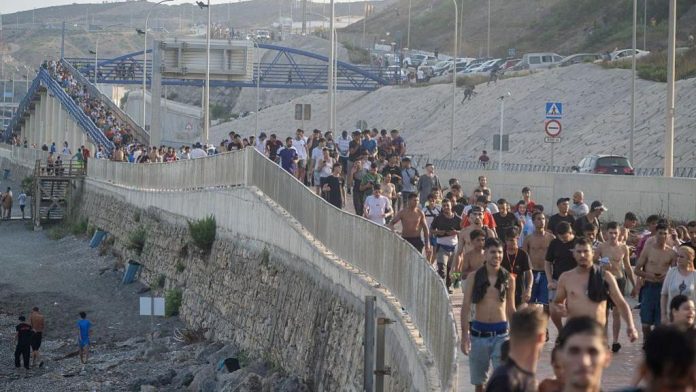
As many of the 60,000 migrants who swam or scrambled their way into Ceuta trickle back into Morocco, the prospect of a dramatic crisis has begun to gently recede.
East Africa News
The political and diplomatic pressure that had piled onto prime minister Pedro Sánchez after the breaching of this key border outpost may begin to fade as an expanded military and police deployment makes itself felt and the authorities process and return those new arrivals who don’t leave of their own volition and fail to qualify for a right to remain.
Many appeared to be Moroccan locals, quite unprepared for the sort of arduous long distance trek undertaken by sub-Saharan migrants who cross the Sahara or risk their lives in fishing boats crossing to the Canary Islands.
Sánchez had rushed to Ceuta on Friday morning to accuse migrant traffickers of exploiting a recent supreme court decision that had constrained the government’s right to immediately deport people who had arrived by sea.
Regional Impact
The last such big incursion into Ceuta, in 2021, saw 10,000 break into the territory, just a sixth of the number estimated to have climbed over or through or swum around its boundary fence in less than 24 hours this time.
In immediate practical terms this episode appears to have been encouraged by Moroccan border guards’ readiness to stand aside and allow anyone â mostly younger or middle aged men but also some women and children – to try to penetrate this nugget of European Union territory on the North African coast, whatever the risks.
And those were considerable: at least 57 people died in the attempt, many seemingly drowned.
Analysis
But the bigger question is why Morocco allowed its normally efficient forces to take such a laissez-faire approach.
And that harks back to acute sensitivities surrounding the kingdom’s relations with both Europe and its neighbour Algeria â a context in which Spain plays a special role.
For it is now more than 50 years since Madrid surrendered the control of what had been its Spanish Sahara territory, in the face of a takeover by the then king of Morocco, Hassan II, while Algeria instead opted to support the indigenous independence movement Polisario, going on to house its supporters in desert refugee camps and host its political leaders.
Stay informed with the latest news on Wararka.so — your trusted source for Somalia and world news.