African and Caribbean nations call for formal apology for transatlantic slavery
African and Caribbean nations call for formal apology for transatlantic slavery
African and Caribbean countries have called for a formal apology and reparations from countries that benefited from the transatlantic slave trade. The demands come at the end of a three day conference in Ghana which looked to advance the push for reparatory justice. He added that the UN resolution was unclear as to “whom the recipients of ‘reparatory justice’ would be”.
The UK has long rejected calls to pay reparations, saying today’s institutions cannot be held responsible for past wrongs. The US ambassador to the UN echoed this, saying his country did not “recognise a legal right to reparations for historical wrongs that were not illegal under international law at the time they occurred”. It follows a landmark UN resolution earlier in March which recognised transatlantic slavery as the “gravest crime against humanity”, urging UN member states to contribute to a reparations fund.
52 countries, including the United Kingdom and European Union member states abstained. Around 12-15 million African men, women and children were captured and trafficked to the Americas to work as slaves from the 15-19th century. It calls for comprehensive debt relief, the restitution of looted cultural property, and the establishment of a global reparations fund, though no specific amount was stated.
The UN General Assembly vote took place in March, with 123 votes in favour, and three votes – the United States, Israel and Argentina – against declaring the transatlantic slave trade a crime against humanity. Most of the reparations paid by governments came in the form of compensation to slave owners in the 19th Century, rather than to those who had been enslaved. The conference leaders also called on countries formerly involved in the slave trade to offer their “full, formal and unconditional apologies”.
It also addresses the disproportionate impact of slavery on African women and girls. “No single set of atrocities should be regarded as more or less significant than another,” UK ambassador to the UN James Kariuki had then said. A 19-point reparations plan has been endorsed as part of the “Next Steps” conference in the Ghanaian capital of Accra.
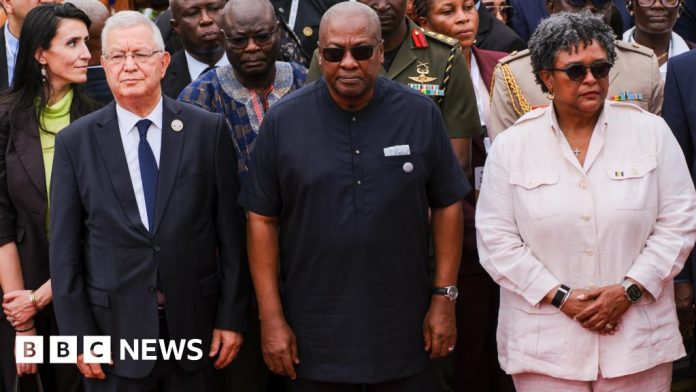
Ghana’s President John Dramani Mahama told delegates: “History does not ask us to inherit guilt, but it asks us to inherit responsibility”. Unlike UN Security Council resolutions, those from the General Assembly are not legally binding. No country has ever paid reparations to the descendants of enslaved Africans or affected African, Caribbean and Latin American nations.
However, he cautioned against reducing reparations for slavery to financial compensation alone, saying they should not be seen as a “cheque written to bring the story to a close”. French President Emmanuel Macron also gave a virtual note at the conference, where he recognised that enslaved people were “dehumanised and treated as goods”. That includes the UK – in the 1830s, following the abolition of slavery, the country paid owners the equivalent of more than $21bn (£16bn) in today’s money.