[ad_1]

Thursday April 24, 2025

Garowe (HOL) — Puntland has firmly rejected a federal government proposal to centralize the registration of internally displaced persons (IDPs) and tie humanitarian aid to a national system, warning that the move undermines Somalia’s federal structure and threatens to politicize relief operations.
The move follows recent talks between the Somali Disaster Management Agency (SoDMA) and the National Identification and Registration Authority (NIRA), during which federal officials discussed linking humanitarian aid distribution to a centralized ID database. Puntland’s leadership has denounced the initiative as a federal overreach that undermines the powers of regional states.
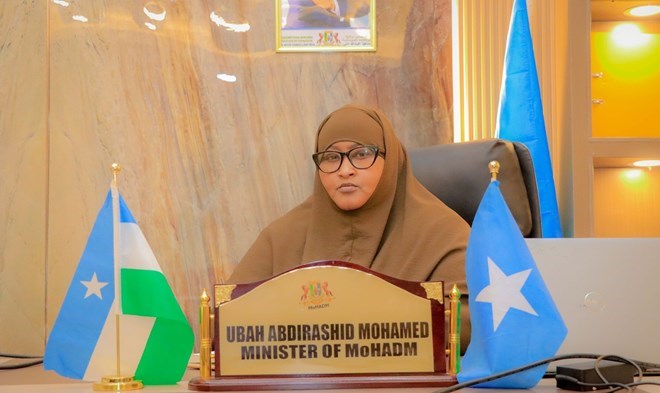
In a strongly worded statement issued Tuesday, Puntland’s Ministry of Humanitarian Affairs and Disaster Management said talks between the federal government agencies raised serious concerns about overreach from Mogadishu.
“The Puntland government expresses serious concern over the recent discussions between SoDMA and NIRA, which involved a proposal to unify the registration of internally displaced persons (IDPs) and link humanitarian assistance to federal registration systems,” the statement read.“This violates the autonomy of federal member states and risks politicizing aid distribution.”
Puntland added that humanitarian aid should be distributed based on need alone, not as a tool for political control.
“Aid should not be used as leverage. It must remain neutral, impartial, and independent,” the ministry added, noting that displaced populations often rely on region-specific responses in conflict-affected areas.
Puntland officials argue the proposal disregards the Provisional Constitution. The administration warned that centralizing these responsibilities at the federal level would erode the federal model adopted in 2012, which was designed to prevent power from becoming overly concentrated in the capital.
The statement also urged the international donor community and humanitarian organizations to reject federal measures that bypass local authorities.
“We call on all partners to uphold the integrity of aid and respect the role of federal member states in managing displacement and emergency relief,” Puntland said.
Somalia’s federal system has long struggled with disputes between Mogadishu and its federal member states. Resource sharing, security coordination, and governance authority have remained flashpoints.
Puntland, one of Somalia’s oldest and most established federal states, has repeatedly clashed with the federal government over what it sees as attempts to consolidate power.
Puntland officials argue that the federal ID rollout lacks legal consensus and transparency, with the Ministry of Interior calling the program “politically driven” and “a threat to Puntland’s autonomy.”
On April 9, Puntland President Said Abdullahi Deni signed his own decree and created the Puntland Identification Authority (PID), which will issue ID cards independent of NIRA.
The decree stands in direct opposition to the federal government’s program.
Prime Minister Hamza Abdi Barre has argued that the rollout is essential to improving national security and restoring public trust in state institutions after more than three decades without a formal identity system. In early April, he instructed all government agencies to enforce the ID requirement for access to healthcare, education, and other essential services.NIRA has begun expanding operations in regional districrts.
The federal system, led by NIRA and supported by a $10.5 million agreement with Pakistan’s NADRA biometric agency, aims to issue 15 million biometric IDs ahead of the 2026 elections.
The ID cards are also seen as a cornerstone for facilitating one-person, one-vote elections—something Somalia has not held since 1967. Although NIRA maintains that the cards are not explicitly linked to the electoral process, regional leaders remain skeptical. They point to the timing of the rollout, its overlap with voter registration, and the influx of donor funding as reasons to question the federal government’s motives.
[ad_2]
Read More