
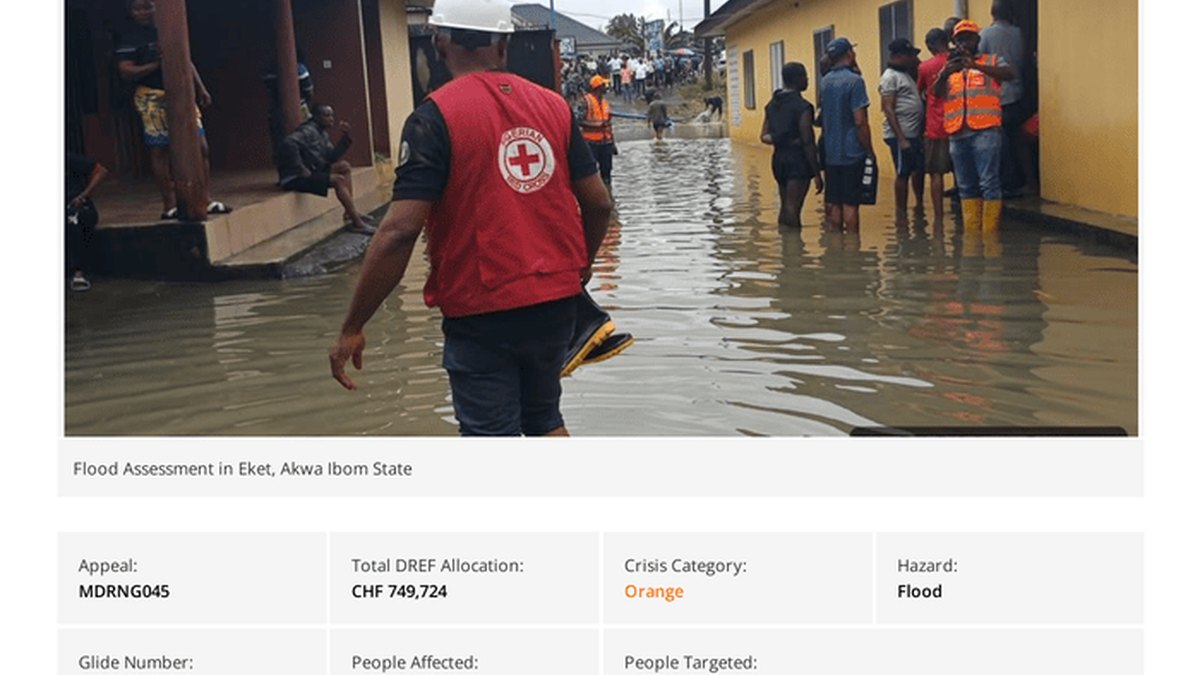
Najiyada Dabagalka Nigeria ayaa ku guuleysatay inay bilowdo xilliga barashada 2026-ka, taasoo keentay in Qarsoodi iyo Caawinaad Ugu Yaraan 73,000 Qof loo diyaariyo. Ururka Xeebaha Nigeria (NRCS) ayaa la shaqaynaya hay'adda IFRC si loo fududeeyo caawinaadka dadka ay saameeyeen dabagalka.
Xaaladda Dabagalka iyo Qarsoodiyada
Najiyada Dabagalka Nigeria ayaa ku guuleysatay inay bilowdo xilliga barashada 2026-ka, taasoo keentay in Qarsoodi iyo Caawinaad Ugu Yaraan 73,000 Qof loo diyaariyo. Ururka Xeebaha Nigeria (NRCS) ayaa la shaqaynaya hay'adda IFRC si loo fududeeyo caawinaadka dadka ay saameeyeen dabagalka. Bishii Sebtembar 2026, ayaa la sameeyay baaritaan ku saabsan xaaladda dadka, kaas oo muujiyay in 54,540 qof ay saameeyeen dabagalka, iyadoo 19,823 qof ay ka mid yihiin dadka la saaray.
Baaritaanka oo lagu sameeyay 14 gobol, ayaa muujiyay in gobolka Ondo uu yahay midka ugu badan ee dadka la saaray, iyadoo 72.4% ka mid ah dadka saameysan ay yihiin kuwa la saaray. Tani waxay muujinaysaa in dabagalku uu saameyn weyn ku yeeshay nolol maalmeedka dadka, gaar ahaan kuwa deggan gobolka Ondo.
Xoojinta Xiriirka Qaranka iyo Caawinaadka
Xiriirka qaranka ayaa xoojintay iyadoo hay'adda NEMA ay bilowday xarunta qaran ee dabagalka (NEOC) bishii Agoosto 2026. Tani waxay ka dhigatay in xiriirka u dhexeeya hay'adaha kala duwan uu noqdo mid aad u xooggan, iyadoo la isku dayayo in la xaliyo dhibaatooyinka dadka saameysan.
Hay'adda NIHSA ayaa soo saartay warbixin ku saabsan dabagalka, kaas oo muujiyay in 15 gobol ay yihiin kuwa ugu daran ee dabagalka saameyn ku yeeshay. Caawinaadka ayaa loo diyaariyay 10 gobol, kaas oo ka kooban 3,000 guriga, iyadoo la filayo in 73,000 qof ay helaan caawinaadka.
Nigeria entered the 2026 rainy season with significant flood exposure, prompting the Nigerian Red Cross Society (NRCS), with IFRC support, to activate an Imminent DREF in July 2026. Between 10 and 16 September 2026, NRCS conducted a multi sectoral assessment across 14 states, covering 3,944 respondents. The assessment estimated that 54,540 people had been affected, including 19,823 displaced people (36.3%).
Rising Humanitarian Impact and National Coordination
As the season progressed, forecast risk materialized into flooding across several parts of the country, resulting in displacement, damage to homes and assets, disruption of livelihoods and access to essential services, and increasing humanitarian needs. Ondo recorded the highest proportion of affected people who were displaced at 72.4%. National coordination was strengthened through NEMA's activation of the National Emergency Operations Centre (NEOC) on 4 August 2026.
NIHSA's National Flood Advisory NFA 2026 262, issued on 19 September and valid through 25 September, identified 15 states at high riverine flood risk, including several within the proposed response footprint. This indicates that the hazard remains active and further flooding is possible.
Latest Operational Data and Proposed Response
The situation has continued to evolve. As of 18 September, the NRCS Emergency Operations Reporting (EOR) dashboard recorded 73,247 people affected and 31,175 displaced, based on 52 incident reports from 11 states and 32 LGAS, with 38 deaths, 1,968 injuries and 53,382 people reported in need. These figures are not combined with the assessment results because the two datasets have different coverage and methodologies.
Against this progression from forecast risk to confirmed humanitarian impacts and continuing flood risk, NRCS proposes to scale up the Imminent DREF to a Response DREF. The proposed Response DREF will cover 10 states: Akwa Ibom, Anambra, Bayelsa, Benue, Cross River, Delta, Edo, Lagos, Ondo and Ogun, providing direct assistance to 3,000 households over six months and indirect support to approximately 73,000 people.
Ilaha iyo xuquuqda sawirka
Sawir: ReliefWeb Updates Xigasho