[ad_1]
The new Pixel 10 series is designed to deliver the best of Gemini on Android, particularly thanks to the new Tensor G5 processor, which enhances on-device AI performance by up to 60%. However, as we found in our Google Pixel 10 Pro review, the Tensor G5 is one of the few major changes compared to last year, and therefore, Google’s new phone has to rely on AI-focused software features.
There are three new AI features of particular note, and all three work to varying degrees of success. One of them is simple, with Google focusing on delivering a long-awaited camera feature. The second summarizes key information from other Google apps in a single location.
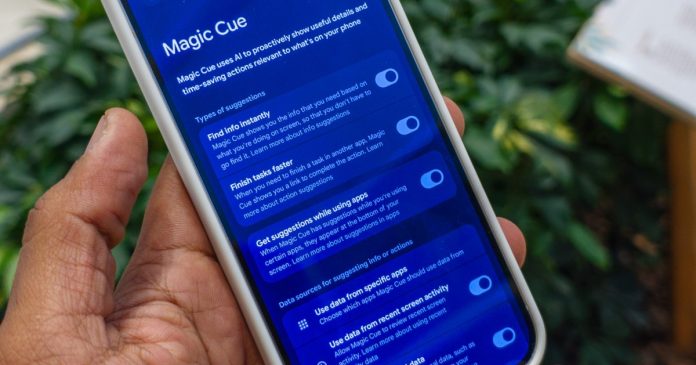
Both of these work fairly well, but the most ambitious feature is the one with the greatest potential, which also happens to be the hardest to implement. Meet Magic Cue, Google’s new suggestive AI that has the potential to transform how you use your phone thanks to Gemini.
Magic Cue is an extremely helpful, suggestive AI
Nirave Gondhia / Digital Trends
If you watched the Pixel 10 launch event, you will have seen a short demonstration of what Magic Cue can do. In short, it’s Google’s attempt at building an agentic AI that can surface key information from various apps.
The premise is simple: every phone user repeatedly has to check information in another app, such as flight details, calendar invites, images of specific people, meeting details, and more. A truly helpful AI assistant should be able to find that information, so you don’t have to. If it takes 1-2 minutes to switch apps, find the information, and copy it to the original app, this will quickly add up to hours and days that an AI can save you.
Magic Cue is the start of a truly useful AI that we deserve
The premise of Magic Cue is brilliant, but as we’ve seen from Apple Intelligence, achieving bold platform-wide agentic AI features is extremely challenging. Magic Cue partially works and is fairly limited, but if Google can overcome these issues, Magic Cue is the start of the AI we deserve.
Google has a few key Magic Cue challenges to solve
Only the bottom prompt yielded a Magic Cue suggested reply Nirave Gondhia / Digital Trends
Key amongst those challenges is the requirement for a personal Gmail account. Yes, while the Daily Hub feature runs on-device and can also access your Workspace calendar information, Magic Cue is limited to just your personal Gmail account.
Google has confirmed to me that this limitation is influenced by the inherent challenges of data security, considering the variety of different Workspace users. While many personal and small business Workspace customers may not be overly concerned with sharing data with AI features like Magic Cue, larger customers with stringent data security requirements — such as those in heavily regulated industries like finance or healthcare — will have more significant concerns.
Nirave Gondhia / Digital Trends
The answer will come in new controls that Google is developing to enable both IT administrators, owners, and end users to control the flow of information. It sounds like an extremely elegant solution, but considering how Daily Hub can access this information without the same concerns, this should be easier to solve. However, the likely challenge is not Calendar entries, but accessing your email, and this is where Magic Cue has incredible potential.
The other key challenge with Magic Cue is the specificity of the prompts required to generate an answer, and as you’ll see below, changing a few words is the difference between a Magic Cue reply showing or not showing.
How Magic Cue works on the Pixel 10 series
Nirave Gondhia / Digital Trends
Magic Cue can draw upon the contents of your Gmail, Calendar, and selected other Google apps to surface a suggested reply containing the information it thinks you will need. However, for similar reasons to the limitations around Workspace accounts, there’s an extremely high threshold of certainty required before Magic Cue will display the prompt.
For example, prompts like “When do you land?” or “When do you land in Berlin?” failed to show the required response, but asking “What time does your flight land in Berlin on September 3rd?” yielded the desired answer.
This specificity means it will be inherently less useful in the short term, but I appreciate that Google has implemented a high threshold before showing that data. Yes, it could be lower, but this threshold will help alleviate any privacy concerns and yield better results in the long term. Setting a high bar gives Google a bigger problem to overcome, and once they achieve that standard, Magic Cue will be better for it.
Nirave Gondhia / Digital Trends
Nirave Gondhia / Digital Trends
If you use your personal Gmail for everything, you’ll love Magic Cue, as it can surface key information in a variety of places. If you’re running late and someone asks for your ETA, you can look up the meeting location in your calendar, consult your location in maps and the expected time of arrival, and provide all of this in a split second, so you don’t need to search for it.
Or, if you’re on a call with an airline, hotel, or train company, it can search your email for the booking and display key information, such as a confirmation number, dates, and price, directly on the call screen, so you don’t need to switch apps.
Magic Cue is fantastic but flawed
Nirave Gondhia / Digital Trends
Magic Cue is an inherently useful AI feature, and it would likely make the Pixel 10 series the best Android phone if Google could solve these limitations. I use my personal Gmail account for some legacy accounts, including most of my accounts with train companies. During a call with Amtrak customer service, I discovered an upcoming booking that I had forgotten about. I also love the suggested reply pill, and this is everything I want in an AI feature.
However, there’s no denying that Magic Cue is flawed, and that’s by design. The Workspace limitations, coupled with extremely specific prompts, mean suggested replies don’t always show when you expect them to. It’s the type of feature that can delight customers, but equally frustrate them when it doesn’t work. If Google can fix the key challenges with Magic Cue, they’ll finally have an AI that is actually worth switching phones for.
[ad_2]